How to build a secret mountain base in Rust that survives a whole wipe
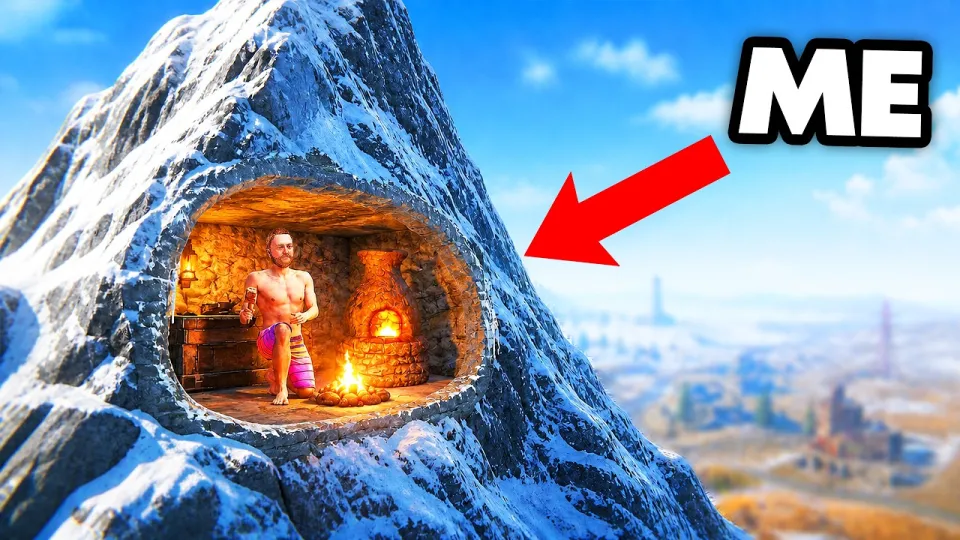
Video: I Lived in a Secret Mountain Base in Rust
Need articles like this for your video? They help promote it on YouTube and Google — order them in the Telegram bot @sat_sit_bot. It writes articles around your video, embeds the video and publishes them on popular niche websites (no ads). Free trial — 50 articles.
· based on the channel Memeio
A secret mountain base in Rust is a small, low-profile structure built into terrain that other players rarely path through — a rock overhang, a narrow ledge, a dip behind a ridge — kept cheap, dark and boring so that nobody bothers to raid it. The goal is not to defeat raiders but to never meet them: a 1x2 or 2x2 of stone on a mountain slope, without external lights or decorations, survives wipes far more often than a fortified compound. The approach is the one Memeio documents in I Lived in a Secret Mountain Base in Rust, and you can follow the same channel's updates via Memeio's X account.
Why a hidden base beats a fortified one in Rust
A hidden base in Rust works because raiding is driven by visibility, not by loot value. Players raid what they see: bases near monuments, roads, quarries and popular spawn beaches, or anything with a light on at night and a furnace smoking at dawn. A small structure on a mountain slope that shows no activity is simply not a target, because raiders have to spend explosives and time on a guess.
That logic is exactly what experienced solo players repeat in the comments under mountain-base videos: the best raid defense is never getting raided, and the way to achieve it is a perfectly hidden location. A 2x2 on a peak, visible from three grid squares away, is the opposite of that — it is a billboard. The practical rule is that footprint, height and lighting matter more than the material tier of your walls.
Choosing a mountain site that nobody walks past
Site selection is 80% of the job, and the right spot has three properties at once: it is hard to reach, it is not on the way to anything, and it hides the build from at least two approach angles.
- Pick dead terrain. Look for slopes between two monuments rather than on the road between them. If a player has no reason to cross that ridge, they never see your door.
- Use natural cover. Rock overhangs, boulders, cliff notches and the shaded side of a peak break the silhouette of a base far better than any camo skin.
- Check the skyline. Stand at the nearest road and at the nearest monument and look up. If you can see the spot, so can everyone else.
- Avoid popular monuments. Launch Site, Military Tunnel and Dome pull constant traffic; a mountain two grids from a quiet corner of the map is worth more than a perfect pocket next to a hot monument.
- Test the walk. Run from the nearest spawn beach to the site. If the route is annoying for you, it is annoying for a raider carrying rockets.
Building small, cheap and quiet
A hidden base should be the smallest thing that holds your wipe. A 1x2 with a triangle airlock, stone walls and a single sheet metal door covers a solo player's needs, and it fits into gaps that a 2x2 cannot. Honeycomb only where the base is exposed; on a truly hidden site, extra walls mostly add cost and noise.
Keep the interior boring on purpose. Do not place furnaces facing an open window, do not run lights, and do not build a shooting floor. Smoke and light are the two things that give a mountain base away at distance, and both are free to avoid. Store loot in small boxes spread across the base rather than one large box, and keep a stash or a second small base with a sleeping bag somewhere else on the map so a single raid does not end your wipe.
Upkeep matters more than people expect. A tiny base costs very little stone and wood per day, which means you can log off for two days and come back to an intact door instead of a decayed shell.
Camouflage that actually helps
Camouflage in Rust is about breaking shapes, not painting them. The most common criticism of "secret" bases is fair: a square box sticking out of a mountain top is invisible only to someone who is not looking. Real camouflage means the base does not produce a recognizable silhouette in the first place.
- Bury the structure in a dip or against a rock face so only one wall is exposed.
- Use the terrain's own colors: stone walls on gray rock, wood on dirt and grass, and no bright skins on doors.
- Skip window frames and embrasures on the visible side; they read as a base from far away.
- Keep the roof at or below the ridge line so nothing pokes above the skyline.
- Do not build a twig starter next to the finished base — the leftover twig is the giveaway that gets both raided.
Eco raiding and early-game tricks worth copying
Mountain bases are cheap, which means your first hours decide how much you can afford to lose. Two habits from experienced players make the early game noticeably smoother.
First, recycle broken wooden spears. A broken spear can be crafted into a stone spear for a small amount of stone, so keeping broken spears ahead of unbroken ones in your inventory effectively doubles the number of throwing weapons you carry into an early fight. Second, treat lucky loot as a bonus, not a plan: a random crate of tools at the start of a wipe is a nice head start, but a run built on it collapses the moment the spawn is contested.
When you do raid, hit bases that are clearly abandoned or poorly defended, take what fits in your inventory, and leave. Every extra minute inside someone else's base is a minute your mountain door sits unwatched.
Common doubts about hidden mountain bases
"Won't someone find it eventually?" Yes, sometimes. A hidden base reduces the chance of being raided; it does not make you invisible, and cheaters with ESP see everything regardless of camouflage. That is why the stash and the backup bag exist.
"Is a tiny base enough for a whole wipe?" For a solo player who crafts on demand and does not hoard, yes. A 1x2 holds a workbench, boxes and a furnace comfortably; the constraint is discipline, not space.
"Do I need to play on a low-population server?" It helps, but the bigger factor is distance from traffic. A well-placed base on a busy server often outlives a badly placed one on a quiet server.
"What about trap bases?" Trap bases are a different genre: they are built to be found and to punish the player who finds them. A secret mountain base is built to be ignored, and mixing the two usually gets you raided by a group that came for the trap.
Useful links
- Memeio on X — channel updates, clips and announcements.
- Epidemic Sound — the music library credited for the video's soundtrack.
The takeaway
A secret mountain base in Rust is a discipline problem more than a building problem: pick terrain nobody crosses, build the smallest base that works, keep it dark and quiet, and spread your loot so one raid is not the end of the wipe. The strategy in I Lived in a Secret Mountain Base in Rust holds up because it accepts that visibility, not armor, decides who gets raided. The channel Memeio is worth following for more solo survival runs built on the same idea. For updates and future videos, check Memeio's X account.
Key takeaways
- Memeio spent a full Rust wipe in a tiny base tucked into mountain terrain and was never raided — the video by that channel documents the whole run.
- A hidden base in Rust works through location, not decoration: a small footprint in terrain nobody paths through beats any camouflage skin.
- The cheapest raid defense is never being found: a 1x2 or 2x2 with stone and a single door is enough to hold a wipe's worth of loot.
- Broken wooden spears can be recycled into stone spears, roughly doubling your early raiding tools for the cost of some stone.
- Cheaters and roaming groups still end hidden runs; a stash, a second sleeping bag and no external lights limit the damage when that happens.
Questions & answers
How do you hide a base in Rust so it does not get raided?
Build small and build where nobody travels. A 1x2 or 2x2 of stone tucked into a rock notch or dip on a mountain slope, with no lights, no smoking furnaces and no twig leftovers nearby, is far less likely to be raided than a large compound. The base should not break the skyline when viewed from the nearest road or monument.
Is a 1x2 base enough to survive a full Rust wipe as a solo player?
For most solo players it is, as long as you do not hoard. A 1x2 fits a workbench, a furnace and several boxes, and its upkeep is cheap enough to survive a couple of days offline. Add a stash or a second small base with a sleeping bag so a single raid does not wipe your progress.
What is the broken spear trick in Rust?
Broken wooden spears can be crafted into stone spears for a small amount of stone, so a stack of broken spears effectively doubles the number of throwing weapons you can bring to an early fight. Keep the broken spears ahead of the unbroken ones in your inventory so the crafting order works in your favor.
Can cheaters still find a hidden mountain base?
Yes. Players using ESP or other cheats see bases through terrain, so camouflage does nothing against them. That is one reason hidden-base runs rely on cheap builds, spread loot and backup spawn points rather than on the assumption that the location is truly invisible.
Source: I Lived in a Secret Mountain Base in Rust · Markdown version